“It is better to be roughly right than precisely wrong.” (John Maynard Keynes)
John Maynard Keynes, one of the greatest economists and risk-taking investors around, strongly advised putting investing on ‘autopilot’, and then going out and enjoying your life!
The basics
Investing can be tricky, even for seasoned professionals who try to buy and sell at the right moment.
Rand-Cost Averaging offers a solution that allows you to easily navigate uncertain markets by automating regular investments. With Rand-Cost Averaging, you invest the same amount in an investment at consistent intervals, regardless of price fluctuations. This strategy may lower the average cost per share or unit trust. This can safeguard you from market volatility and remove the need to time your purchases perfectly.
Who’s it good for?
This strategy is excellent for inexperienced investors who are risk-averse and are scared to wade in. It could be a great way to start investing.
But it’s also a good way of reining in impulsive risk takers. A risky approach can get you interested in edgy companies which may (or may not) be the market’s next lightning bolt. Rand-Cost Averaging imposes discipline and removes the temptation to chase the next big thing.
A simple example
Imagine you have R600 that you want to invest in a unit trust over 6 months, instead of investing it all at once.
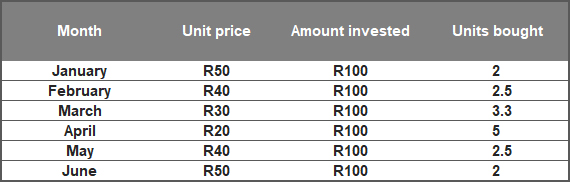
Total Investment: R600 over 6 months
Total units bought: 2 + 2.5 + 3.33 + 5 + 2.5 + 2 = 17.33 units
Average price per unit: R34.62
- If you had invested all R600 in January when the unit price was R50, you would have bought only 12 units (R600 ÷ R 50 = 12).
- By using Rand-Cost Averaging, you bought 17.33 units at an average price of R34.62 per unit, a much lower price than if you had bought everything upfront.
- Of course, you could have lucked out and bought the units in April, when they cost just R20. But this is a gambler’s mentality, not an investor’s.
Life offers no guarantees
Rand-Cost Averaging is great, but there is one important caveat. The entire concept assumes that over time, markets tend to rise.
While this is generally true for most sound investments, you certainly don’t want to consistently allocate money towards an investment that’s consistently underperforming. If you’re buying at a low point month after month and not seeing a return, then you may be sinking money into an investment that is not likely to make gains. That’s a position that no investor wants to be in, so think twice about using a consistent approach in this case.
Set it and forget it
Before you start setting up debit orders, you’ll need to find out how much you can afford to dedicate to your chosen investment. If you’re investing for retirement, there is no one-size-fits-all answer to how much you should save for retirement, but academic studies based on historical data can give you a ballpark figure. We’d advise aiming to save around 15% of your net income (i.e. after tax) if you’re early in your career.
Let’s sum up the benefits
- Lower costs: Rand-Cost Averaging can help reduce the average price paid for investments over time.
- Regular investing: It builds a practice of consistent investing, something that’s essential for long-term wealth growth.
- No speculation: By removing the pressure of market timing, Rand-Cost Averaging ensures you’re always in the market.
- Emotional control: It tempers the urge to make reckless decisions that could harm your portfolio.
- Risk mitigation: It helps prevent large, ill-timed lump sum investments.
- Universal appeal: Both beginners and veterans benefit from the disciplined, emotion-free approach of Rand-Cost Averaging.
Is there ever a place for lump sum investing?
Of course there is. You may have a large sum to invest from the sale of a business or an inheritance for instance. Ultimately, the best approach depends on your financial situation, risk tolerance, and investment goals. To achieve benefits similar to those of Rand-Cost Averaging you might want to consider making your investment in phases.
But there may be an opportunity cost to holding part of the lump sum in a cash-related investment instead of diving straight into equity.
The bottom line
In many cases, the consistency that Rand-Cost Averaging brings to your financial life is an asset in itself. Please do call us if you’d like to discuss any of the above.
Jason Yutar: +27 83 415 9603 or
Zaheera Mohammed: +27 82 775 1898
Disclaimer: The information provided herein should not be used or relied on as professional advice. No liability can be accepted for any errors or omissions nor for any loss or damage arising from reliance upon any information herein. Always contact your professional adviser for specific and detailed advice.
© FinDotNews