For many South Africans, the fact that the rand weakens over time against the dollar feels like the biggest reason for investing offshore. When you think that one dollar cost less than R7 in 2011 compared to over R17 today, it seems obvious that having money offshore is imperative.
Over long periods of time, this trend will probably hold. The rand is likely to steadily get weaker. But it’s important to understand why. Primarily, this is due to South Africa having a higher inflation rate and a higher risk premium than developed markets. Significantly, both of these things mean that returns from South African assets should also be higher.
It’s complicated
The past year has been a very good one for South African investments. Local property has gained more than 50%, and both shares and bonds are up more than 20%.
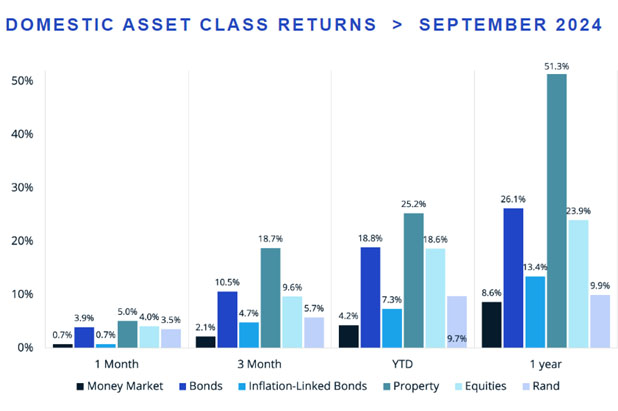
Image source: Visio Fund Managers
Notably, the rand has also been strong. It’s gained around 10% against the dollar in the past 12 months.
This is only a short period, but it’s a reminder that markets never move only in one direction. After many years of South Africa underperforming, local assets have been very strong this year. This further highlights the importance of having a diversified portfolio.
In the long run, these factors and rand weakness actually tend to even themselves out. In dollar terms, the returns you earn in South Africa have actually been better over long periods of time than you could earn just about anywhere else – ours is the third-best performing stock market in the world in dollar terms in the period between 1900 and 2019.
Are you a gambler or an investor?
While the fluctuating rand often seems like the only reason you could ever need to seek refuge in offshore investments, there are far more meaningful reasons to diversify internationally.
Currency movements are notoriously difficult to predict, and the rand is no exception. Over the years, the rand has experienced periods of significant depreciation, only to stabilise or even strengthen later.
For example, the rand weakened sharply during the 2008 global financial crisis and again in 2015 during the “Nenegate” scandal. This alarmed many investors, who sent large sums of cash offshore. In both instances, the currency subsequently regained some strength, resulting in losses for those investors. Relying on these short-term movements as the main reason for investing offshore is speculative and risky, especially for long-term investors.
D is for diversification
The primary reason to invest offshore should be to diversify your portfolio, not to hedge against a weak rand. South Africa represents only a small fraction of the global economy, and offshore investments provide access to a broader range of sectors, industries, and companies that are not well-represented in the South African market.
Global markets, especially in developed economies, offer exposure to industries like technology, healthcare, and renewable energy that may not have the same growth potential locally. Diversifying into these sectors allows you to tap into global trends and reduce the risk of being overexposed to South Africa’s economic cycles.
We all know that South Africa faces many structural challenges, including political instability, slow economic growth, and reliance on commodity exports. Investing in global markets allows you to reduce your exposure to local risks and focus on economies that are more stable and diversified.
For example, the COVID-19 pandemic hit South Africa hard. However, international markets, particularly in the US and Europe, recovered quickly due to massive government stimulus packages and the strength of large multinational companies. Investors with offshore exposure were able to benefit from this global recovery.
The proof is in the pudding
The underlying growth in global equities and bonds – as opposed to the performance of the rand – is what ultimately drives these gains.
This theory is borne out in practice. Historical data shows that globally diversified portfolios tend to outperform South African-only portfolios in risk-adjusted terms over long periods.
The final word
Ultimately, offshore investing should be part of a broader, long-term plan focused on diversification, asset allocation, and risk management. The rand’s movements should not be the primary driver of this decision. Instead, you should look to global markets for access to growth opportunities, protection against local economic risks, and better risk-adjusted returns.
To discuss how best to diversify your investment portfolio, speak to us.
Jason Yutar: +27 83 415 9603 or
Zaheera Mohammed: +27 82 775 1898
Disclaimer: The information provided herein should not be used or relied on as professional advice. No liability can be accepted for any errors or omissions nor for any loss or damage arising from reliance upon any information herein. Always contact your professional adviser for specific and detailed advice.
© FinDotNews